0:10
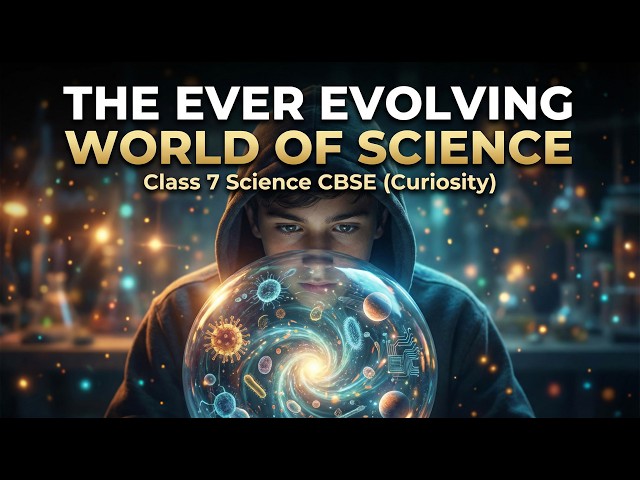
Hi everyone, welcome to the start of a
0:12
brand new adventure. This year we aren't
0:14
just looking at a textbook full of
0:16
facts. Instead, we are accepting an
0:18
invitation to question, experiment, and
0:20
explore the beautiful world we live in.
0:22
From the smallest cells to the furthest
0:24
stars, let's begin our journey into the
0:26
heart of discovery. What is science? It
0:29
is more than just memorizing data for a
0:31
test. It is the act of looking at the
0:33
world with fresh eyes and asking what is
0:35
happening here. It encourages us to move
0:37
from being passive learners to active
0:39
explorers of our surroundings.
0:48
The world of science covers everything
0:50
near and far, small and large. We might
0:53
spend one day testing materials we find
0:55
in our own kitchens and the next day
0:57
discussing how the sun and stars move
0:59
across the vastness of space. Nothing is
1:01
too small or too far to investigate.
1:12
Have you noticed the page numbers in
1:13
your book? They follow the flight of a
1:15
butterfly and a paper plane. This is a
1:17
reminder that learning takes flight only
1:19
when curiosity leads the way. When we
1:21
wonder why, our imagination reaches for
1:33
Great things often start simply. Did you
1:36
know that the dream of flying began with
1:38
people just watching birds and playing
1:40
with paper planes? From those simple
1:42
observations, early inventors and modern
1:44
engineers built the incredible aircraft
1:46
we see today. Science turned simple
2:01
Science is a process, a specific way of
2:03
thinking. It's a mindset that doesn't
2:05
fear the unknown, but welcomes it. By
2:07
training our minds to be curious and
2:08
open, we learn to navigate the world
2:10
with a scientific spirit that stays with
2:21
This year we are going deeper. We won't
2:24
just ask what something is. We will ask
2:26
how things work and why events happen
2:28
the way they do. We will look for the
2:30
hidden patterns in nature that explain
2:32
the logic of our environment.
2:45
To truly understand science, we must
2:47
step out of the classroom and the
2:49
textbook. Real science happens through
2:51
direct experience, through the
2:53
activities and experiments that allow us
2:54
to touch, see, and feel the concepts we
3:07
Every experiment you perform is a
3:09
stepping stone. These hands-on
3:10
experiences build the foundation for a
3:13
much deeper understanding of the
3:14
environment we live in. They help us
3:16
find our place on this planet and see
3:18
that discovery never truly ends.
3:30
Science isn't just about discovery. It's
3:32
about responsibility. As young
3:34
explorers, you will see how our human
3:36
activities are linked to the natural
3:37
world. Science gives us the tools to
3:39
address environmental challenges and
3:41
create a sustainable world for everyone.
3:53
Although we have different chapters for
3:55
physics, chemistry, biology, and earth
3:57
science, they are all interconnected. An
3:59
idea in one field often inspires a
4:02
discovery in another. Remember,
4:04
everything in science is part of one big
4:16
Now that we understand how to think like
4:18
scientists, let's take a look at what we
4:20
will be exploring this year. We are
4:22
about to go on a journey through
4:23
different fields to see science in
4:25
action all around us.
4:34
We begin at home. Have you ever wondered
4:36
why some fruits are sour? or why a
4:38
yellow turmeric stain on your uniform
4:40
changes color when you wash it. We'll
4:42
use these everyday mysteries to start
4:44
our exploration of the properties of
4:56
Next, we'll play with batteries, lamps,
4:58
and wires. We will experiment to see
5:01
what it takes to make a lamp glow and
5:03
discover which materials allow
5:04
electricity to pass through them and
5:17
This exploration of electricity will
5:19
lead us to a major scientific milestone,
5:21
classification. We will enter the world
5:23
of metals and non-metals, learning how
5:25
to group materials based on the unique
5:27
properties we've observed.
5:35
The changes occurring in our
5:36
surroundings are of two types. The
5:39
change may be reversible or sometimes
5:40
the change may be irreversible.
5:47
Change is everywhere. Some changes like
5:50
melting ice can be reversed. Others like
5:52
a battery running out or fruit ripening
5:55
are irreversible. We will learn to
5:57
distinguish between these types of
5:58
changes to understand how matter
6:10
Heat plays a key role in accelerating or
6:12
causing many changes. In the reversible
6:15
example of melting ice, heat flows into
6:17
the ice cube, causing a state change. We
6:19
will investigate how heat flows from one
6:21
place to another and why it makes
6:23
certain processes happen much faster
6:37
The sun's heat is the engine of the
6:39
water cycle. It causes water to
6:41
evaporate from the seas, which then
6:42
falls as rain, trickling deep into the
6:45
ground. We'll see how this cycle
6:46
connects air, land, and water in a
6:58
It isn't just the world around us that
7:00
changes. We change, too. During your
7:02
middle school years, your body is
7:04
growing and changing rapidly. We will
7:06
dive into biology to understand why this
7:15
All animals need specific processes to
7:18
survive. We eat to get nutrients. We
7:20
breathe for air. and our blood
7:22
circulates those nutrients everywhere
7:23
they are needed. We'll explore these
7:25
vital systems that keep us alive.
7:37
But what about plants? They don't eat
7:39
like we do, yet they grow. We will
7:41
investigate how plants make their own
7:43
food and how they breathe, discovering
7:45
the beautiful balance life has figured
7:57
Science also helps us track time. Long
7:59
ago, humans used shadows in the sun to
8:01
tell the hour. Today, we have digital
8:04
clocks. We'll look at how we measure
8:06
time and the speed at which things
8:17
Light helps us see, but it also explains
8:19
the universe. By studying light and
8:21
shadows, we can understand why we have
8:23
day and night and how the movements of
8:25
the Earth and Moon create spectacular
8:40
As you do these experiments, remember
8:42
that a scientist isn't someone with all
8:44
the answers. A scientist is someone who
8:46
keeps asking questions, even when an
8:48
experiment confirms what they already
8:58
We end our preview with a challenge.
9:00
Question the answer. Instead of finding
9:02
an answer to a question, I will give you
9:04
the answer and you must dream up the
9:06
most creative, curious question
9:07
possible. Let's turn our thinking around
9:09
and start exploring. Thanks for watching
9:11
the video. For more information, videos
9:13
and PowerPoint presentation slides,
9:15
visit our website given in the
9:17
description. Thank you. Do subscribe,
9:19
like, share and comment. Meet you in the
9:21
next video. Until then, take care.