live_tv
Livestream Starting Soon
00
Hours
:
00
Minutes
:
00
Seconds
Up next in 10

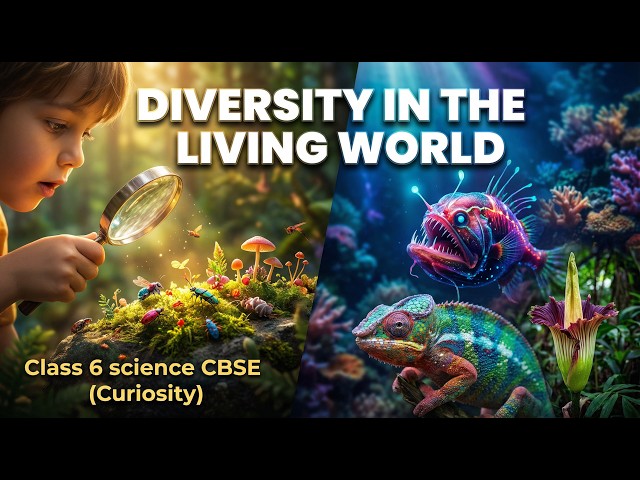
Diversity in the living world | CBSE | Class 6 science curiosity easy Explanation for Students.
Welcome to this engaging lesson on Diversity in the Living World from Class 6 Science (CBSE / NCERT) – Curiosity. In this video, we explore the amazing variety of living organisms on Earth and understand how scientists group them based on their characteristics.
Our planet is home to millions of living organisms including plants, animals, microorganisms, and more. Learning about their diversity helps us understand nature better and appreciate the beauty of life around us.
This video is designed for Class 6 CBSE and NCERT students to understand the concept in a simple, clear, and interesting way.
📚 What You Will Learn
• What is biodiversity
• Diversity among living organisms
• Different types of plants and animals
• Why classification of living things is important
• Examples of living organisms around us
This lesson will help students build a strong foundation in biology and environmental awareness.
🌐 Visit our website for more science lessons, notes, quizzes and interactive tools:
👉 https://physicsxtreme.in�
🎯 Who This Video Is For
✔ Class 6 CBSE students
✔ NCERT Science learners
✔ School exam preparation
✔ Teachers and parents helping students learn science
👍 Like | Share | Subscribe for more CBSE Science lessons and educational videos.
Show More Show Less View Video Transcript
0:09
Hi everyone. Imagine stepping outside
0:12
after a refreshing rain. Can you hear
0:14
that? Each bird has its own unique
0:15
chirp. A beautiful sign of nature's
0:17
variety. Today, we're going on a nature
0:20
walk to explore the amazing plants and
0:22
animals around us. As we walk, remember
0:24
to respect every living creature. We are
0:26
here to observe and learn, not to
0:28
disturb.
0:34
As we look around, we see so much
0:36
variety. From tiny blades of grass to
0:39
giant trees and from fluttering
0:40
butterflies to playful monkeys. This
0:42
wide range of living things found in a
0:44
specific area is what we call
0:46
biodiversity. Every single region has
0:48
its own unique mix of life that makes it
0:50
special.
0:55
Did you know that these plants and
0:56
animals are actually best friends? They
0:58
depend on each other to survive. Trees
1:01
provide food and cozy shelters for birds
1:03
and monkeys. In return, animals help the
1:06
trees by spreading their seeds far and
1:07
wide after eating their fruits. It's a
1:10
perfect circle of life. With so many
1:12
living things, how do scientists study
1:14
them all? We use grouping or
1:17
classification. Just like you might
1:18
organize your school bag, we group
1:20
plants and animals based on their
1:22
similarities and differences. This makes
1:24
it much easier to understand the vast
1:26
world around us.
1:38
Let's start with the smallest group,
1:39
herbs. These are typically short plants
1:42
with soft and green stems. A great
1:44
example is the tomato plant. If you feel
1:46
the stem, it's quite tender compared to
1:48
the woody plants we see in the park.
1:58
Next, we have shrubs. These are
2:00
medium-sized plants, not as tall as
2:02
trees, but sturdier than herbs. They
2:05
have many brown woody stems that start
2:07
branching out very close to the ground.
2:09
Think of a rose plant. Its stems are
2:11
hard, but they aren't very thick.
2:23
Now look up. Trees are the giants of the
2:26
plant world. They have hard, thick,
2:28
woody stems called trunks. Unlike
2:31
shrubs, a tree's branches usually start
2:33
much higher up on the stem, away from
2:35
the ground. The mighty mango tree is a
2:37
perfect example of this structure.
2:49
Some plants have stems so weak they
2:51
can't stand up on their own. Climbers
2:53
use support to grow upwards, reaching
2:55
for the sun. But creepers take a
2:58
different path. They simply spread out
2:59
and grow along the surface of the
3:01
ground. Both have adapted to their weak
3:03
stems in clever ways.
3:15
If you look closely at a leaf, you'll
3:16
see thin lines called veins. This
3:19
pattern is called venation. Hibiscus
3:21
leaves have a net-like pattern called
3:23
reticulate venation. But look at a
3:24
banana or grass leaf. The veins run in
3:26
straight lines alongside each other. We
3:28
call that parallel venation. Just as
3:31
leaves differ, so do roots. A taproot
3:34
system, like in a mustard plant, has one
3:36
thick main root with smaller ones
3:38
growing off it. On the other hand,
3:40
fibrous roots, like you find in common
3:42
grass, look like a bunch of thin,
3:44
similarsized threads.
3:48
Even seeds tell a story. If a seed can
3:50
be split into two parts, like a
3:52
chickpea, we call it a dicatalon or
3:55
dicot. If it has just one part like a
3:57
maze or corn kernel, it's a monocottalen
4:00
or monocott. These tiny parts are called
4:03
kodalons.
4:07
Here is a secret scientific link. Nature
4:09
is very organized. Generally, plants
4:12
with reticulate leaves always have tap
4:14
roots and are d cuts. Meanwhile, plants
4:16
with parallel venation always have
4:18
fibrous roots and are monocots. By
4:20
looking at just one part of a plant, you
4:22
can predict the others.
4:25
Animals are just as diverse. We can
4:28
group them by how they move. Some fly
4:30
through the air using wings. Others walk
4:32
or jump on land using legs. And some
4:34
crawl. By looking at their movement,
4:36
shape, size, and color, we can begin to
4:38
understand their incredible diversity.
4:46
We've learned that grouping isn't just
4:47
about labels. It's about seeing the
4:49
patterns in nature. From the height of a
4:51
tree to the split of a seed, these
4:53
features help us study life
4:54
systematically. But why do these
4:56
differences exist? Stay tuned as we
4:58
explore habitats next.
5:05
Have you ever wondered why a cactus
5:07
doesn't grow in the snowy mountains? Or
5:09
why a deodorar tree isn't found in the
5:11
desert? It's because the surroundings,
5:13
the temperature, water, and soil are
5:15
completely different in every region,
5:17
and life must change to survive. The
5:19
Earth is a complex mosaic of extreme
5:21
conditions from scorching sands to
5:23
freezing winds. Biodiversity is not
5:26
random. It's the result of continuous
5:28
biological engineering. Every region
5:30
demands a different blueprint for
5:31
survival. Our exploration begins by
5:34
zooming into the specific designs life
5:36
uses to conquer the planet's harshest
5:37
surroundings. To survive in these
5:39
different regions, plants and animals
5:41
develop special features. These quote
5:44
survivals tools are called adaptations.
5:46
Adaptation is defined as the presence of
5:48
specific bodily features or habits that
5:51
allow an organism to survive and thrive
5:53
in its surroundings. Life doesn't just
5:55
endure its environment. It reverse
5:57
engineers solutions to environmental
5:59
problems, leading to a perfect fit for
6:01
environmental compatibility.
6:17
In the hot deserts of Rajasthan, water
6:20
is like gold. Desert flora like the
6:22
cactus is a hydration reservoir. It
6:25
survives scorching heat and minimal
6:27
water availability with thick fleshy
6:29
stems for maximum internal water
6:31
storage. Its leaves are reduced to
6:33
spines providing structural defense and
6:35
preventing water loss while also
6:37
protecting it from thirsty predators.
6:50
Camels are desert masters, but they
6:52
aren't all the same. Hot desert camels
6:54
have long legs and wide hooves to walk
6:56
on hot sand. But in cold deserts like
6:59
Leidda, camels have shorter legs for
7:01
mountains, two humps for food storage,
7:03
and long hair to stay warm in winter.
7:08
Deserts animals are experts at saving
7:10
water. Camels, for instance, lose very
7:12
little water from their bodies. They
7:14
excrete only tiny amounts of urine.
7:16
Their dung is very dry and they don't
7:18
even sweat. This allows them to go many
7:21
days without a single drink.
7:26
High in the mountains, the challenge is
7:28
snow. If too much snow piles up,
7:30
branches break. That's why diodar trees
7:33
are shaped like cones. Their sloping,
7:35
flexible branches allow the heavy snow
7:37
to simply slide off, keeping the tree
7:39
safe and healthy.
7:45
Wind is another mountain hurdle. On the
7:47
highest peaks of the Neil girus,
7:48
roodendrrons grow shorter and have much
7:50
smaller leaves. This adaptation helps
7:53
them stay low and reduce the force of
7:55
the heavy winds so they don't get blown
7:56
away or damaged.
8:04
Aquatic life faces the unique challenge
8:07
of operating in a dense viscous medium.
8:09
Fish employ a specialized hydrodnamic
8:11
architecture. Featuring a smooth,
8:13
streamlined body shape and highly
8:15
effective fins to minimize drag and
8:17
maximize propulsion efficiency, allowing
8:19
for rapid movement through water.
8:22
Every living thing has a place where it
8:24
naturally lives and grows. This natural
8:27
home is called its habitat. A habitat is
8:30
more than just a place to sleep. It
8:32
provides everything an organism needs:
8:34
food, water, air, and shelter.
8:44
Habitats on land are called terrestrial
8:46
habitats. From the thick canopy of a
8:48
forest and the open spaces of a
8:50
grassland to the harsh extremes of
8:52
deserts and mountains, these land-based
8:54
homes shape the biodiversity of our
8:56
entire planet.
9:02
Water-based homes are aquatic habitats,
9:05
including ponds, rivers, and vast
9:07
oceans. But some animals, like the frog,
9:09
are amphibians. They are special because
9:12
they are adapted to live in both worlds,
9:14
spending time in the water and on land.
9:19
Adaptation is crucial for survival.
9:21
Organisms without appropriate
9:23
adaptations for their environment often
9:25
cannot thrive or even survive. Sadly,
9:28
when a habitat is damaged, biodiversity
9:30
suffers. Without a home or food, animals
9:33
cannot survive. In India, iconic animals
9:36
like the Bengal tiger and the great
9:37
Indian bustard have seen their
9:39
populations drop because their natural
9:41
homes are being lost.
9:55
Many heroes have fought to protect our
9:57
nature. Janaki Amal, a famous botonist,
10:00
helped save the beautiful Silent Valley
10:02
forest and Salem Ali, the birdman of
10:05
India, traveled across the country to
10:06
document and preserve the habitats of
10:08
our amazing birds.
10:13
The government is also taking action.
10:15
Project Tiger was started in 1973 to
10:17
save our national animal. More recently,
10:20
in 2022, the cheetah reintroduction
10:22
project began to bring back cheetahs to
10:24
India. These projects give endangered
10:26
species a second chance.
10:31
Finally, we have sacred groves. These
10:34
are special patches of forest protected
10:36
by local communities for generations. No
10:38
one is allowed to cut trees or harm
10:40
animals here. These groves are community
10:43
treasures that keep our planet's
10:44
biodiversity thriving. Remember that
10:46
every organism is a finely tuned
10:48
machine, perfectly optimized for its
10:50
habitat. Thanks for watching the video.
10:52
If you like this video, please do
10:54
subscribe, like and share. Comment your
10:57
ideas and suggestions which will give us
10:59
a lot of motivation. Thank you.
#Science
#Science
#Biological Sciences
#Ecology & Environment