Up next in 10

Welcome to Physics Xtreme!
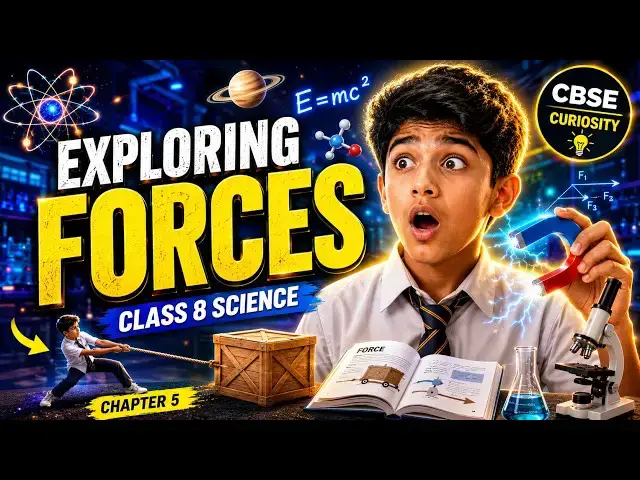
In this video, we learn CBSE Class 8 Science – Chapter 5: Exploring Forces from the latest Curiosity textbook. The concepts are explained in a simple, clear, and interesting way to help students understand the chapter thoroughly and prepare confidently for school exams.
📘 Chapter Covered:
• Exploring Forces (Chapter 5)
🎯 In this video, you will learn:
✔️ What is Force?
✔️ Types of Forces
✔️ Contact Forces
✔️ Non-contact Forces
✔️ Balanced and Unbalanced Forces
✔️ Effects of Force
✔️ Everyday Examples
✔️ Important CBSE Exam Concepts
🌐 Visit our website for more Physics learning resources:
https://physicsxtreme.in
If you found this video helpful:
👍 Like the video
💬 Leave your doubts in the comments
📤 Share it with your friends
🔔 Subscribe to Physics Xtreme for more CBSE Science and Physics videos.
#Class8Science
#CBSE
#CBSEClass8
#ExploringForces
#Curiosity
#PhysicsXtreme
#Science
#Force
#Education
#Study
#Students
#NCERT
#ScienceClass8
#Physics
#Learning
Show More Show Less View Video Transcript
0:05
[music]
0:07
>> Welcome to the first part of our journey
0:09
into the world of physics. Today, we're
0:12
going to begin exploring forces. From
0:15
the simple act of walking to the complex
0:18
motion of the planets, forces are the
0:20
invisible hands [music] that make
0:22
everything happen.
0:24
We'll discover what a force actually is
0:26
and how it interacts with the world
0:28
around us.
0:29
Let's get started. Think about your
0:31
daily life. Why does it feel so much
0:34
harder to pedal your bicycle when you're
0:36
going uphill compared to flat ground?
0:38
And why is it so easy to lose your
0:41
footing and slip on a wet surface?
0:43
These aren't just accidents. They are
0:45
direct results of forces at work. By the
0:49
end of this lesson, you'll be able to
0:50
explain exactly why these things happen.
0:53
So, what exactly is a force?
0:56
>> [music]
0:56
>> In science, we keep it simple. A force
0:59
is a push or a pull applied to an
1:01
object. Think of opening a heavy door or
1:04
dragging a suitcase. In every case, you
1:07
are applying a force to change how that
1:09
object sits or moves in space. It's the
1:12
most basic building block of motion.
1:15
Forces don't just exist in isolation. A
1:18
force only comes into play when at least
1:20
two objects interact with each other.
1:23
For example, when you push a table, your
1:25
hand is one object and the table is the
1:28
other. If you stop touching the table,
1:30
the interaction ends and the force
1:32
disappears. It's always a two-way street
1:35
between objects.
1:37
To talk about forces accurately, we need
1:39
to measure them. The standard scientific
1:42
unit for force is the Newton, named
1:44
after the famous scientist Sir Isaac
1:46
[music] Newton. We use the symbol
1:48
capital N to represent it. Just like we
1:51
use meters for distance, we use Newtons
1:53
to describe how strong a push or pull
1:56
is.
1:57
One of the most obvious things a force
1:59
can do is make a stationary object move.
2:03
Imagine a football sitting on the grass.
2:05
It won't move an inch until your foot
2:07
applies a force to it. That sudden push
2:10
overcomes the ball's desire to stay
2:13
still and sets it in motion.
2:15
Forces can also change the speed of
2:18
something that's already moving. If
2:20
you're riding a bike and you pedal
2:22
harder, you're applying more force to
2:24
speed up. Conversely, when you pull
2:26
[music] the brakes, you're applying a
2:28
force that slows the bike down or brings
2:30
it to a complete stop. What if you want
2:33
to change where an object is going? A
2:36
force can do that, too. When a batsman
2:39
hits a cricket ball, the force of the
2:41
bat changes the ball's direction
2:43
instantly.
2:44
By applying force at an [music] angle,
2:46
you can steer objects exactly where you
2:49
want them to go. Finally, force can
2:51
change the very shape of an object.
2:54
Think about squeezing a sponge or
2:57
pressing an inflated balloon. The push
2:59
from your hands forces the material to
3:02
stretch or compress.
3:04
Some objects return to their original
3:06
shape, while others stay changed
3:09
forever.
3:09
>> [music]
3:10
>> Scientists divide all these forces into
3:12
two main categories based on how they
3:15
act. Contact forces happen only when two
3:18
objects are physically touching at all.
3:21
We'll focus on contact forces first. The
3:24
most common contact force we use is
3:26
muscular force. This is the force
3:29
created by our muscles when they
3:30
contract and elongate. We use it to
3:33
walk, lift bags, or kick balls.
3:37
For centuries, humans have also relied
3:39
on the muscular force of animals, like
3:42
oxen, to help with heavy tasks like
3:44
plowing fields.
3:45
>> [music]
3:46
>> Did you know muscular force works inside
3:48
you even when you're sitting still?
3:51
Your heart is a muscle that applies
3:53
force to circulate blood through your
3:55
body.
3:56
Muscles also push food through your
3:58
digestive system.
3:59
These internal forces are absolutely
4:02
essential for our survival every single
4:04
second. Have you ever wondered why a
4:07
rolling ball eventually stops on its
4:09
own?
4:10
This is due to a contact force called
4:13
friction.
4:14
Friction is the force that comes into
4:16
play whenever an object moves or even
4:19
tries to move over another surface. It
4:22
is the silent break of the physical
4:24
world. The most important thing to
4:26
remember about friction is its
4:28
direction. It always acts in the
4:30
opposite direction to the motion of the
4:32
object. If you push a box to the right,
4:35
friction pushes back to the left. This
4:38
constant opposition is what causes
4:40
moving objects to slow down and stop.
4:43
Why does friction happen? Even surfaces
4:46
that look perfectly smooth have tiny
4:48
microscopic bumps and irregularities.
4:51
When two surfaces touch, these
4:53
irregularities lock into each other like
4:55
puzzle pieces.
4:57
To move the object, you have to apply
4:59
enough force to break this lock. This is
5:02
why rough surfaces, which have more
5:04
bumps, create much more friction than
5:06
smooth ones.
5:07
>> [music]
5:07
>> We looked at forces that require touch,
5:10
but did you know some forces can act
5:12
across empty space?
5:14
Today, we explore non-contact forces and
5:18
the fascinating ways forces work in
5:20
fluids like water and air.
5:22
Prepare to see the world's invisible
5:24
pulls and pushes.
5:26
Non-contact forces are often called
5:29
action at a distance forces. They can
5:31
push or pull an object without any
5:34
physical contact at all.
5:36
Think of a magnet attracting a paperclip
5:38
from a few centimeters away.
5:40
The force is traveling through the air
5:42
itself. Let's look at the three main
5:45
types.
5:46
First up is magnetic force.
5:49
Magnets can exert force on magnetic
5:51
materials like iron or on other magnets.
5:55
Remember, like poles such as north and
5:57
north will repel or push each other
6:00
away,
6:01
but unlike poles, north and south will
6:04
attract or pull each other together.
6:06
Have you ever had static cling? This is
6:10
electrostatic force. When you rub
6:12
certain materials together like a comb
6:15
on your hair, static electrical charges
6:17
build up on the surface.
6:19
These charges can then exert a force on
6:21
other objects like small pieces of
6:23
paper, pulling them in without ever
6:26
touching them.
6:27
The most famous non-contact force is
6:30
gravitational force or simply [music]
6:32
gravity.
6:33
Gravity is the force with which the
6:35
Earth pulls all objects toward its
6:37
center. It's the reason why an apple or
6:40
a coconut always falls down to the
6:43
ground instead of floating away into the
6:45
sky.
6:46
In science, weight isn't just a number
6:48
on a scale. It's a measurement of force.
6:51
Specifically, [music]
6:52
weight is the measure of how strongly
6:54
the Earth's gravity is pulling on an
6:56
object. Because it is a force, we
6:59
measure weight in Newtons just like any
7:01
other push or pull.
7:03
People often confuse mass and weight,
7:06
but they are very different. Mass is the
7:09
actual amount of matter in an object and
7:11
it never changes no matter where you are
7:14
in the universe.
7:15
Weight, however, is the force of gravity
7:18
on that mass.
7:19
Your mass would be the same on the moon,
7:21
but your weight would change because the
7:23
moon's pull is different. Since
7:25
different planets have different
7:27
gravitational pulls, your weight changes
7:30
depending on where you stand. On the
7:32
moon, gravity is only about 1/6 as
7:35
strong as on Earth, so you'd feel much
7:37
lighter.
7:38
On a massive planet like Jupiter,
7:40
however, the pull is so strong, you
7:43
would weigh more than twice as much as
7:45
you do now.
7:46
To measure weight, we often use a spring
7:49
balance. It's a simple device with a
7:51
spring fixed at one end. When you hang
7:54
an object from the hook, the Earth's
7:56
gravity pulls the object down,
7:58
stretching the spring.
8:00
The more the spring stretches, the more
8:02
the object weighs.
8:04
Before using any tool, you must
8:06
understand its scale. Look at this
8:09
balance. The difference between 0 and 1
8:12
N is divided [music] into five small
8:14
parts.
8:15
If we divide 1 by 5, we find that each
8:18
small division represents 0.2 N.
8:22
This smallest value is crucial for
8:24
getting accurate measurements in the
8:26
lab.
8:27
Forces aren't just for solid objects.
8:29
They happen in liquids, too. When you
8:32
try to push an empty bottle underwater,
8:35
you feel a strong upward push. This
8:38
force applied by a liquid in the upward
8:40
direction is called upthrust or buoyant
8:43
force.
8:44
It's the reason objects feel lighter
8:46
when they're in water.
8:47
Whether an object floats or sinks is a
8:49
battle between two forces.
8:52
Gravity pulls the object down, while
8:54
buoyant force pushes it up. If gravity
8:57
is stronger than the buoyant force, the
8:59
object sinks, like a coin. But if the
9:02
buoyant force is equal to the object's
9:04
weight, it floats, like a large wooden
9:07
block.
9:08
Now, let's talk about pressure. Pressure
9:11
is the force applied per unit area.
9:14
Think of a thumbtack. You push on the
9:17
wide, flat head, but the tiny, sharp
9:20
point easily pierces the wall.
9:22
Because the force is concentrated on
9:25
such a tiny area at the tip, the
9:27
pressure becomes high enough to cut
9:29
through solid material. In liquids,
9:32
pressure changes with depth. [music]
9:34
The deeper you go, the more the weight
9:36
of the water above you presses down,
9:39
creating higher pressure.
9:41
This is why water from the bottom of a
9:43
leaky tank shoots out with the most
9:45
force, and why deep sea submarines need
9:48
incredibly thick hulls to avoid being
9:50
crushed. Finally, we have atmospheric
9:54
pressure.
9:55
We live at the bottom of a massive ocean
9:58
of air called the atmosphere. This air
10:00
has weight, and it presses down on
10:03
everything with immense force.
10:05
You don't feel it because the pressure
10:07
inside your body balances it out. But as
10:10
you climb a high mountain, there is less
10:12
air above you, so the pressure drops,
10:14
making it harder to breathe.
Jobs & Education
Science